
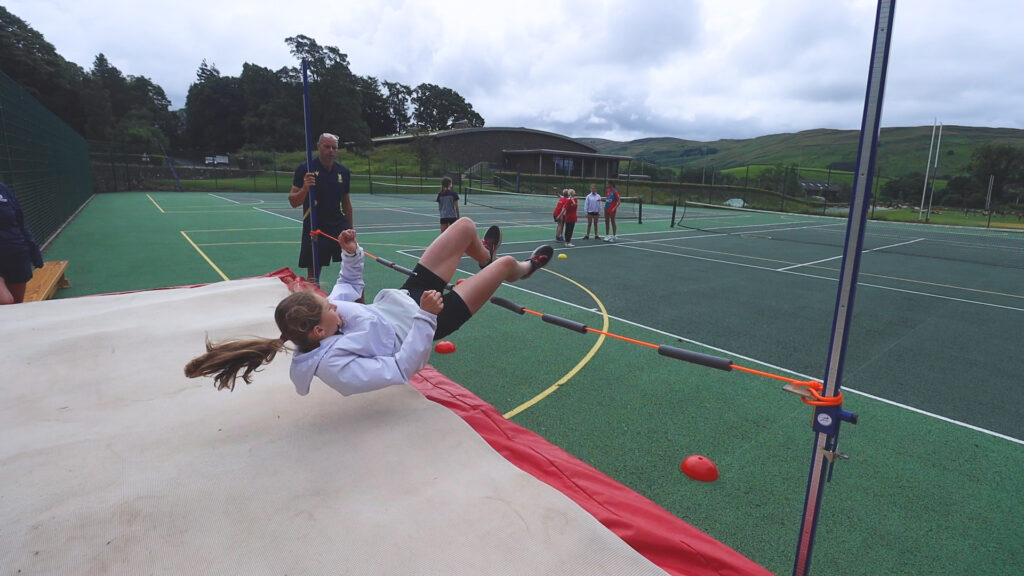
What does good long-term development look like for a young athlete, and how do holiday courses contribute to that?
What does good long-term development look like for a young athlete, and how do holiday courses contribute to that?
In youth sport, progress is often measured in snapshots. A stronger performance this season. A selection moment. A results table. But the reality is that good long-term athletic development is rarely linear, and it cannot be rushed.
At Sedbergh Courses, we spend a lot of time asking a simple but important question:
What does a young athlete need to thrive not just this year, but over the next five, ten, or even twenty years?
Long-term development is not about acceleration
One of the biggest misconceptions in youth sport is that early specialisation or constant competition automatically leads to future success. In fact, the opposite is often true.
Good long-term development is built on:
- Robust movement skills, not early technical perfection
- Decision-making and adaptability, not rehearsed patterns alone
- Confidence, curiosity and enjoyment, not fear of mistakes
- Resilience and self-motivation, not external pressure
Athletes who flourish over time are those who are exposed to variety, encouraged to think for themselves, and supported to grow at the right pace for them — physically, mentally and emotionally.
So where do holiday courses fit in?
When designed well, holiday courses can play a powerful role in this long-term picture. Not as a replacement for school or club sport, but as a different environment with different benefits.
At Sedbergh Courses, our holiday programmes are intentionally built to offer things that young athletes don’t always get during term time:
- Space to explore and experiment without selection pressure
- Coaching that prioritises learning over outcomes
- Mixed-ability, mixed-background groups that encourage adaptability
- Time to reconnect with enjoyment, especially after long seasons
A well-structured holiday course should leave a young athlete curious, energised and confident, not physically or mentally drained.
Development happens between the lines
Progress is not only made during drills. Often, the most meaningful development happens in moments that aren’t labelled as “training” at all.
Shared challenges. Informal competition. Problem-solving. Reflection. Learning to work with new people in a new environment.
For those who take advantage of our residential programme, that also adds an important layer to this. Living, training and socialising together over several days helps young athletes develop:
- Independence and self-management
- Stronger communication skills
- A sense of belonging and shared purpose
- Perspective beyond their usual peer group
These are qualities that serve them just as well in sport as they do in school and life beyond it.
Avoiding the ‘more is better’ trap
One of the risks in youth sport is assuming that more sessions, more hours, more intensity automatically equals better development. Sustainable progress is about quality, balance and intent.
Holiday courses should complement existing programmes, not overload them. That is why our courses are carefully designed to strike the right balance between:
- Challenge and recovery
- Technical input and creative freedom
- Structure and spontaneity
The aim is not to send athletes home “exhausted but improved”, but stronger in their thinking, clearer in their movement, and more motivated to keep learning.
Looking beyond the next season
The young athletes who succeed in the long term are rarely those who were rushed. They are the ones who were allowed to grow — supported by adults who understood that development is a process, not a deadline.
Holiday courses, when done properly, can be a valuable part of that process: a moment to reset, to explore, to be inspired, and to return to everyday sport with renewed confidence and perspective.
That is the role we believe Sedbergh Courses should play — not just delivering great experiences in the holidays, but contributing meaningfully to the long-term development of young people, on and off the pitch.
